Tuesday, November 25, 2014

Tuesday/Wednesday, 25/26 November, 2014

ESSENTIAL QUESTION: How is Ebola Spread?

NGSSS: SC.912.N.1.1

BENCHMARKS:
-Define a problem based on a specific body of knowledge.


LEARNING OBJECTIVES:  Students will be able to:
-read an article and watch a video to find evidence that supports a claim.
-complete a claim, evidence, and reasoning exercise based on two sources of information.


BELL RINGER: Read the first paragraph of the article. Write the question the article addresses.

VOCABULARY: virus, virology, DNA, RNA, airborne

HOME LEARNING: work on your science fair paper/project.

Students completed the claim, evidence, reasoning handout based on the article and the video (see below). Four of the pieces of evidence should come from the article, and two pieces of evidence should come from the video. Be sure to interpret what the evidence means to you, using phrases such as: I think this means, or, this demonstrated to me that... You can find the article and the CER handout pages below the video link.
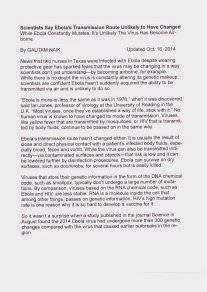


These are the handouts for the video and article. Read the article. Watch the video. Complete the entire Scientific Reasoning Chart based on the article and the video. Use 4 facts from the article and 2 facts from the video.

Monday, August 18, 2014

Monday/Tuesday, August 18/19, 2014

Essential Question: What are things made of and how do they change?

NGSSS: SC.912.N.1.1

Daily Doable Objective: At the end of this class, I should be able to
-explain why knowledge of chemistry is central to other scientific endeavors.
-describe different areas of chemistry.

Bell Ringer: Why might this creature interest you if you were a chemist?

Welcome to Dr. Gayden's Chemistry class! we will explore the world of chemistry by reading, experimenting, and doing projects. You will learn how chemistry is a part of your everyday world.

Use this site as a means to study, to review information presented in class, to find out what was covered in class on days you were absent, to find handouts and rubrics for assignments, and to use as your homepack when you are out. You will find handouts, virtual activities to do in lieu of a hands-on lab, and powerpoints with information presented.


On this first day of school, we reviewed school-wide policies, the vision statement, and expectations. We reviewed the year in chemistry and the big ideas in chemistry. You will get a handout of this information at a later date to place in your interactive notebook.

We began construction of our interactive notebook. See me for further instructions if you were absent.

We watched the video What good can chemistry do? 

We then completed the handout on chemistry, which serves as our notes for the day by viewing a power point presentation on chemistry. The handouts can be found here. 


These handouts are to be completed and placed in your interactive notebook.


The power point can be seen in video form here.


Our HOTS (Higher Order Thinking) questions were: Why would a student who wants to be a doctor or nurse study chemistry? What is the relationship between pure chemistry and applied chemistry?

Students should place all materials in the interactive notebook, using the Cornell notes format. See me if you are not sure how to do this. Don't forget, your notebook must also have a table of contents. You should write three leveled questions that can be answered from information from today's notes. Color coordinate the questions with the answers, using three differently colored highlighters. Also, write a summary of the main points presented in today's lesson.