Tuesday, September 26, 2017

Tuesday/Wednesday, 26/27 September, 2017

ESSENTIAL QUESTION: What is Density?

BENCHMARKS: SC.912.P.8.2

LEARNING OBJECTIVES:  Students will be able to:
-Contrast mixtures and pure substances.
-Distinguish between elements, compounds, and mixtures.

BELL RINGER - Watch video Can you solve the Boat Puzzle and answer question.

VOCABULARY: chemical change, chemical property, physical change, physical property, homogeneous, heterogeneous, element, compound, mixture, substance, extensive properties, intensive properties, density, mass, volume

HOME LEARNING: HL 4 Density    HL 5 Density
These pages are HL 4. Place your answers on this sheet and I will copy.

This is HL 5. Write directly on the page and I will copy for you.

AGENDA
WHOLE GROUP

Students reviewed HL 4 and 4 as their bell ringer.

Students finalized the handouts and information for topic 3 in their notebook, including questions and summary.

Students then put together the remaining pages in their notebook, which consisted of pages:

5: the log to record scores on major District exams, for each benchmark.

6: individual independent assignment log

7: year at a glance

8: major projects/papers for the year

a: Costa's leveled questions for the left hand column of the Cornell notes.

b. examples of quality questions for the left hand column

c and d: standards that will be tested during the 8th grade Science FCAT. This includes all the big ideas taught in 8th grade and the     annually accessed standards from 6th, 7th, and 8th grade that will be included on the test.

inside back cover: contact information/password log

Students spent the remainder of the period in individual remediation on past topics.

Classes that needed to complete the exit ticket from the Venn diagram did so.

Friday, September 22, 2017

Friday/Monday, 22/25 September, 2017

ESSENTIAL QUESTION: How are properties used to describe matter?

BENCHMARKS: SC.912.P.8.2

LEARNING OBJECTIVES:  Students will be able to:
-Contrast mixtures and pure substances.
-Distinguish between elements, compounds, and mixtures.

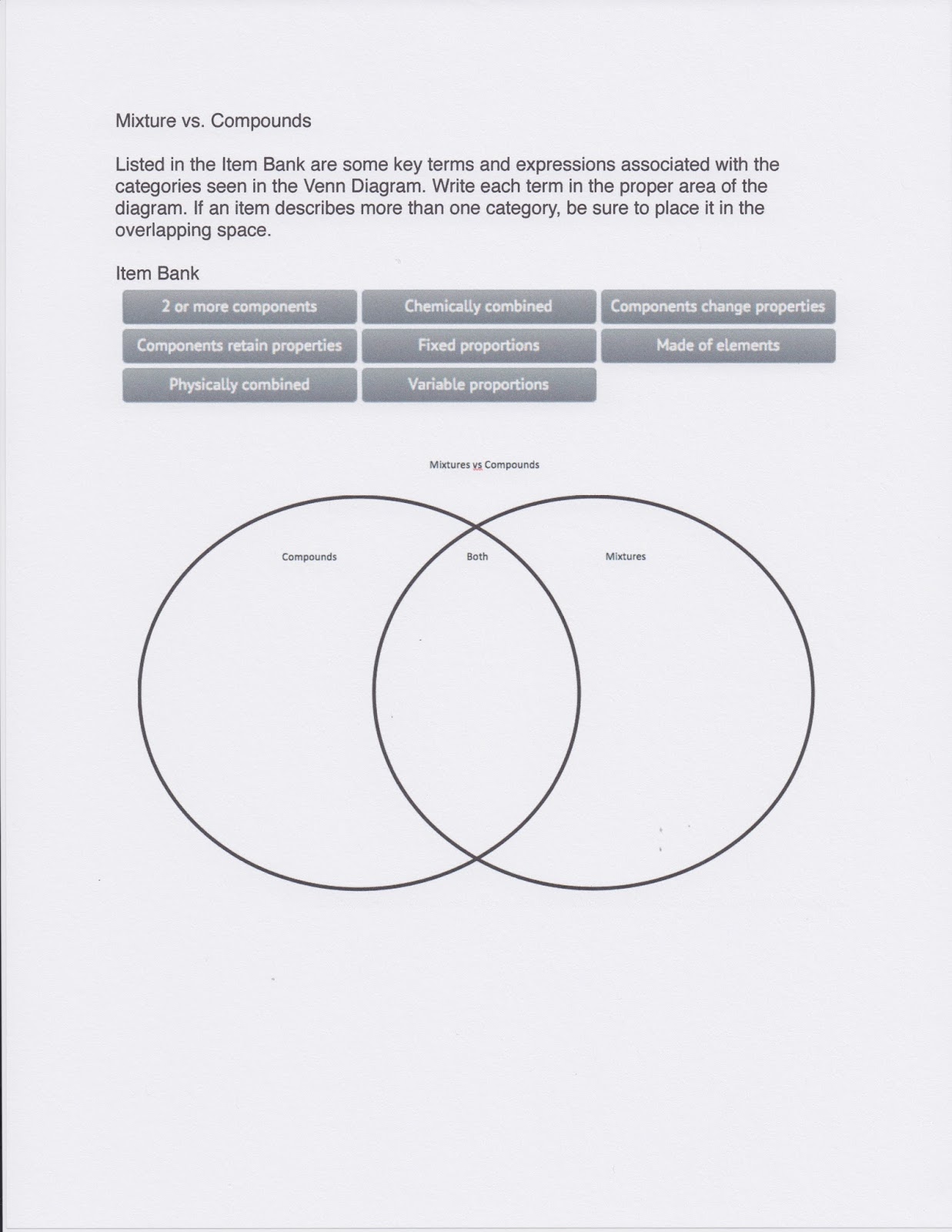
BELL RINGER - Mixtures vs Compounds Venn Diagram


VOCABULARY: chemical change, chemical property, physical change, physical property, homogeneous, heterogeneous, element, compound, mixture, substance, extensive properties, intensive properties

HOME LEARNING: HL 4 Density    HL 5 Density


 The above is HL 4


The above is HL 5


AGENDA
WHOLE GROUP

Students completed the Venn diagram on mixtures vs compounds as the bell ringer.

We then reviewed the Bozeman video and completed the concept map on matter and the phases of matter, which can be found below. The video is also found below.


Complete as you watch the video below on matter


We then reviewed and explained how to complete HL 4 and HL 5, as seen above.

Notes on matter were continued. You can find the power point presentation in video form below.


Students will use the completed Venn diagram to write a comparison and contrast paper on pure substances and mixtures as their exit ticket.

Wednesday, September 20, 2017

Tuesday/Wednesday, 20/21 September, 2017

Students took the pre test in chemistry.

Students also received HL 3, the Density Logic Puzzle

Students began working on the GIZMO Mystery Powder Analysis

Tuesday, September 5, 2017

Tuesday/Wednesday, 05/06 September, 2017

ESSENTIAL QUESTION: How are properties used to describe matter?

BENCHMARKS: SC.912.P.8.2

LEARNING OBJECTIVES:  Students will be able to:
-Contrast mixtures and pure substances.

-Distinguish between elements, compounds, and mixtures.

BELL RINGER: Scientific Method Variables quiz/Physical and Chemical Properties

VOCABULARY: chemical change, chemical property, physical change, physical property, homogeneous, heterogeneous, element, compound, mixture, substance, extensive properties, intensive properties

HOME LEARNING: HL 2: Elements, Compounds and Mixtures

AGENDA
WHOLE GROUP

Students completed a quiz on variables.

Students then completed a bell ringer on physical and chemical properties.


Students received Home Learning 2, which can be found above. It is due next class period.

Students began notes on matter classification. You can watch the power point in video form below. Just click to pause so you can add your notes.


Students should prepare for a baseline exam next week.

Thursday, August 31, 2017

Thursday, 31 August and Friday, 01 September, 2017

ESSENTIAL QUESTION: How are properties used to describe matter?

BENCHMARKS: SC.912.P.8.2

LEARNING OBJECTIVES:  Students will be able to:
-Contrast mixtures and pure substances.
-Distinguish between elements, compounds, and mixtures.

BELL RINGER: Scientific Method Variables quiz

VOCABULARY: chemical change, chemical property, physical change, physical property, homogeneous, heterogeneous, element, compound, mixture, substance, extensive properties, intensive properties

HOME LEARNING: HL 2 Elements, Compounds, and Mixtures 

AGENDA
WHOLE GROUP
There was no class meeting on Thursday due to the Student Orientation.
Class on Friday was individualized instruction.
We will continue the current lesson next class.
There will be a baseline assessment this week in Chemistry.


Tuesday, August 29, 2017

Tuesday/Wednesday, 29/30 August, 2017

Benchmark:  SC.912.N.1.1

Essential Question: How can we use the scientific method to solve problems?

Learning Objectives: By the end of this lesson, I should be able to:

-Evaluate a scientific investigation using evidence of scientific thinking and problem solving.
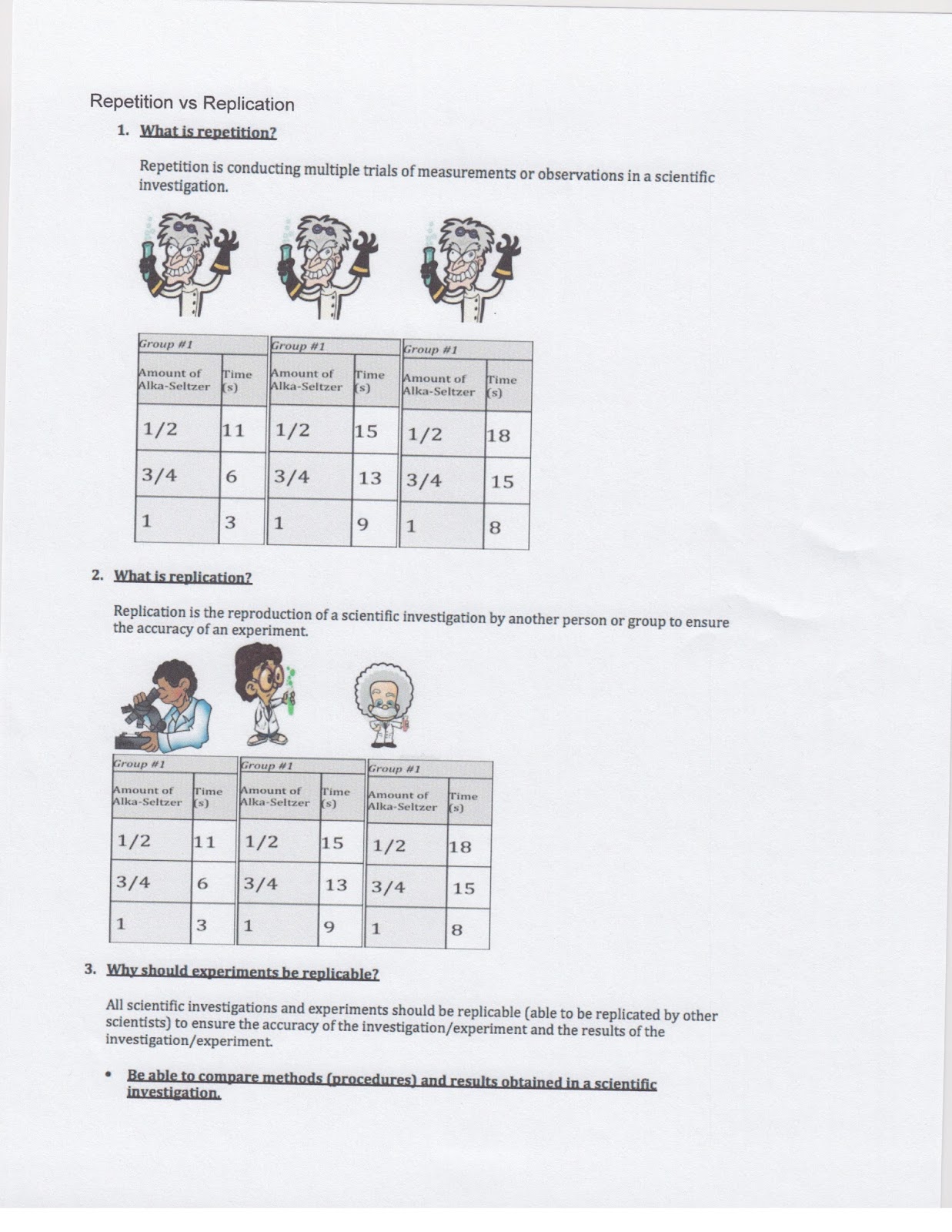
-Differentiate between replication and repetition and evaluate the use and need for each in a scientific investigation.

Bell Ringer: None

VOCABULARY: observations, systematic observations, experiment, test (independent variable), outcome (dependent variable), data, empirical evidence, predict, hypothesis, trials, repetition, replication, control group, conclusion

Home Learning: notebook update

AGENDA
WHOLE GROUP
-update notebook, including Costa's leveled questions, color, and summary. 
-Question 1-What are the steps of the scientific method?
-Question 2-Compare and contrast independent and dependent variables.
-Question 3-Design an experiment that uses the scientific method to solve a problem.

Be sure to color coordinate the questions and answers. Use a different highlighter for each question. See me if you have any questions.

Also, place a summary on the bottom of page 11. It should read:
The scientific method is a way to solve problems. The steps include asking a question, doing research, forming a hypothesis, doing an experiment, making observations and gathering data, analyzing results, drawing conclusions and sharing findings.

SMALL GROUP/INDEPENDENT PRACTICE/DI
-drops on a penny lab. Use the scientific method to investigate how the difference of the sides of the penny affects the number of drops that can fit.
You should have:

Drops on a Penny

Problem: Which side of a penny holds the most drops of water?

Hypothesis: If drops of water are placed on a penny, then the  (heads/tail) side will hold the most drops because.....)

Materials: cup, water, dropper, penny, paper towel

Procedures:
1) Fill a dropper with water.
2) Place a penny heads up on a table.
3) Add water to the surface of the penny. Count each drop as it is added. Be sure NOT to touch the tip of the dropper to the growing dome of water on the penny. STOP adding when the water spills off the penny.
4) Repeat for the tails side of the penny.

Variables;
Independent Variable: Side of the penny
Dependent Variable: Number of drops added
Constants: same penny, same dropper, same liquid

Data and Observations

Results: The _________ side of the penny held more water.

Conclusions:
Claim: The _________ side of the penny held the most drops of water.

Evidence: The heads side held  ______ drops of water. The tails side held _____ drops of water. This was a difference of _______ drops.

Reasoning: Surface tension is the ability of water molecules to stick to each other. Since the penny is made of the same material on both sides, the surface tension should be equal on both sides. The difference in the number of drops added, if any, cold be due to errors in experimentation.


Exit Strategy - Orally review one thing you learned today in class. 

Friday, August 25, 2017

Friday/Monday, 25/28 August, 2017

Friday, 25 August, 2017

Benchmark: SC.8.N.1.1

Essential Question: How can we use the scientific method to solve problems?

Learning Objectives: By the end of this lesson, I should be able to:

-Evaluate a scientific investigation using evidence of scientific thinking and problem solving.
-Differentiate between replication and repetition and evaluate the use and need for each in a scientific investigation.

Bell Ringer: Observation vs Inference handout.


VOCABULARY: fire blanket, eye wash station, first aid kit, evacuation map, fire extinguisher, fume hood, safety shower: observations, systematic observations, experiment, test (independent variable), outcome (dependent variable), data, empirical evidence, predict, hypothesis, trials, repetition, replication, control group, conclusion

Home Learning: notebook update

AGENDA

WHOLE GROUP

-Bell Ringer - Observation vs Inference handout  -add table of contents/assignment sheets/Zombie notes to notebook/add Costa's leveled questions, color, and summary -scientific method and variables/repetition and replication/experimental design handouts and notes:
You can find the notes in movie form below:


SMALL GROUP/INDEPENDENT PRACTICE/DI-drops on a penny lab. Use the scientific method to investigate how the difference of the sides of the penny affects the number of drops that can fit.

Exit Strategy - summarize your notes. 

Thursday, August 24, 2017

Wednesday/Thursday, 23/24 August, 2017

Benchmark: SC.912.N.1.1

Essential Question: What makes a science lab safe?

Learning Objectives:
Students will be able to:
-Determine the five basic rules of lab safety.

-Identify do’s and don’t that make a laboratory activity safe or unsafe.

BELL RINGER- join.quizizz.com for review quiz on lab safety.

SUPPLIES/TECHNOLOGY:  white board and markers, computer(s) with internet access, LCD projector

VOCABULARY: fire blanket, eye wash station, first aid kit, evacuation map, fire extinguisher, fume hood, safety shower

HOME LEARNING: notebook update
  
AGENDA
WHOLE GROUP
-Bell Ringer - lab safety quiz on join.quizizz.com 10 min
-I do - collect and review HL 1 Analyzing elements of the scientific method and the vocabulary sheet 5 min
-we do - place all of table of contents pages and the assignment recorder pages in the notebook; complete the table of contents for the safety lesson, and add HL 1 to page 1 list of assignments. See me for these handouts. 30 min
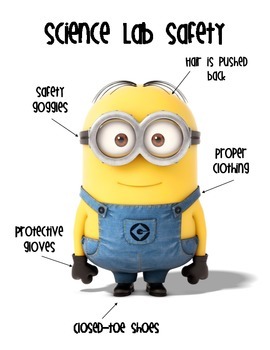
-we do - add minion to the center portion of the notes and write a caption for the picture. 5 min
-I do/we do - place Zombie lab safety notes on page 10 of notebook, and ask Costa leveled questions, using highlighters to correspond the questions with the answers. 20 min

The questions are as follows:
1) What are the five rules of lab safety?
2) Compare and contrast the chemical safety rules do's and don'ts.
3) What hazards might result if lab safety is not maintained?

You should be able to find the answers for questions 1 and 2 directly on the handout. Question 3 should be answered as a paragraph. You can write it on the Zombie page if you run out of space.

See me to determine how a completed Cornell notes page should look.

SMALL GROUP/INDEPENDENT PRACTICE/DI
notebook construction


-you do - exit ticket - summarize lab safety notes 5 min

This is the minion handout that goes in your notebook.


Saturday, August 19, 2017

Monday/Tuesday, 21/22 August, 2017

Welcome to Chemistry!

Benchmark:  SC.912.N.1.1

Essential Question: What makes a science lab safe?

Learning Objectives:
Students will be able to:
-Determine the five basic rules of lab safety.

-Identify do’s and don’t that make a laboratory activity safe or unsafe.

BELL RINGER- Following Directions Handout 5 minutes

SUPPLIES/TECHNOLOGY:  white board and markers, computer(s) with internet access, LCD projector

VOCABULARY: fire blanket, eye wash station, first aid kit, evacuation map, fire extinguisher, fume hood, safety shower

HOME LEARNING: HL 1 Analyzing Elements of the Scientific Method-Use the supplied vocabulary to answer A-F on your own paper.  
AGENDA
WHOLE GROUP
-Bell Ringer - Following directions handout 5 min
-I do - introduction of self/motivational talk 5 min
-I do - review: vision statement, schedule, syllabus, rules, expectations, fire/code red/code yellow drills. 20 min
-I do - distribute and explain HL 1 Analyzing elements of the scientific method and the vocabulary sheet 2 min
-we do - set up notebooks so that we can begin placing pages in the notebook. 20 min
-we do - Zombie College The 5 rules of lab safety video /handout10 min
-we do - review lab safety contract 

SMALL GROUP/INDEPENDENT PRACTICE/DI
-you do - visit website to find the SWAY on Lab Safety and complete the game portion. 10 min

-you do - exit ticket - write to explain the importance of one of the 5 rules of lab safety. 5 min

Today, we will explore Lab Safety. Use your phone to log into your Office 365 site. Visit the sway listing for you.

If you cannot find the link, click on the one listed below:

Laboratory Safety

If you did not get a syllabus, see me. Also, be sure to get a copy of the receipt of syllabus, which must be signed by both you and your parent/guardian.

Additionally, see me to pick up a copy of the lab safety contract.

Below, find a copy of the home learning, the vocabulary supplement, and the Zombie College Lab Safety handout. All of these will be placed in your interactive notebook.


Today, we will explore Lab Safety. Use your phone to log into your Office 365 site. Visit the sway listing for you.

If you cannot find the link, click on the one listed below:

Monday, October 3, 2016

Make Up Lab for Separation of Mixtures

Students who have an excused absence on record should click the link below to visit the virtual lab Separation of Mixtures. Follow the instructions to complete the activity. Record your results and information on the handout you were given. Be sure to answer the analysis and observation questions. Remember to write in blue or black ink.

Separation of Mixtures