Monday, August 31, 2015

Tuesday/Wednesday, 01/02 September, 2015

ESSENTIAL QUESTION: What are things made of and how do they change?

RELEVANCE: How am I ever going to use this information in my real life?


NGSSS: SC.912.N.1.1

LEARNING OBJECTIVES:  Students will be able to:
-Explain why knowledge of chemistry is central to other scientific endeavors.
-Describe different areas of chemistry.
-Take a baseline exam in chemistry. 

VOCABULARY: matter, chemistry, organic chemistry, inorganic chemistry, biochemistry, analytical chemistry, physical chemistry

HOME LEARNING: none

AGENDA
WHOLE GROUP
Students returned their signed syllabus page indicating that they and their parent have read and understood the syllabus for the biology class. Students not returning the signed page should do so as soon as possible.

Students then took the baseline Chemistry exam. We will have data chats once the results are tabulated.

Chemistry students, click the link below to access the Chemistry Baseline Exam. You may use the printed Periodic Table to help you with the questions. Once you complete the exam, be sure to click the submit button. You must answer all questions for your test to score.

Chemistry Baseline Examination

Friday/Monday, 28/31 August, 2015

ESSENTIAL QUESTION: What are things made of and how do they change?

RELEVANCE: How am I ever going to use this information in my real life?


NGSSS: SC.912.N.1.1

LEARNING OBJECTIVES:  Students will be able to:
-Explain why knowledge of chemistry is central to other scientific endeavors.
-Describe different areas of chemistry.
-Design and evaluate a scientific investigation using evidence of scientific thinking and problem solving.

VOCABULARY: matter, chemistry, organic chemistry, inorganic chemistry, biochemistry, analytical chemistry, physical chemistry

HOME LEARNING: Bring back your signed syllabus receipt.

AGENDA
WHOLE GROUP

We collected and reviewed HL 1. Remember, you will be placing your copy in your notebook.

Students received their updated syllabus. It is to be read and placed in the class folder. Have your parent/guardian read the syllabus and sign,. You should also sign and bring the document page with the signature only back to the next class.
-I do - collect and review HL 1

Classes that had not completed the GIMO Disease Spread did so, along with the CER portion as the conclusion.

We then continued construction of interactive notebook pages from inside front cover to page 8, and the back inside cover and pages a through e.

Wednesday, August 26, 2015

Wednesday/Thursday, 26/27 August, 2015

ESSENTIAL QUESTION: What are things made of and how do they change?

RELEVANCE: How am I ever going to use this information in my real life?


NGSSS: SC.912.N.1.1

LEARNING OBJECTIVES:  Students will be able to:
-Explain why knowledge of chemistry is central to other scientific endeavors.
-Describe different areas of chemistry.
-Design and evaluate a scientific investigation using evidence of scientific thinking and problem solving. 

VOCABULARY: matter, chemistry, organic chemistry, inorganic chemistry, biochemistry, analytical chemistry, physical chemistry

HOME LEARNING: HL 1 Introduction to Chemistry

AGENDA
WHOLE GROUP

We continued working on the GIZMO Disease Spread. Should you need to complete your work at home, please see me for a username and password.

We began construction of our interactive science notebook. The composition book will be kept at home, since it is a STUDY TOOL! You are required to maintain your notebook and have it ready to grade at any time.

Tuesday, August 25, 2015

Monday/Tuesday, 24/25 August, 2015

Monday/Tuesday, 24/25 August, 2015

Welcome back to a new year at COPE South!

I hope each of you has had a restful summer and that you're ready to begin a new year of learning and achievement!

When you visit this site, you will find pertinent information about the class structure for the day. You can find home learning links, links to videos, virtual labs, and powerpoint here. Occasionally, you may be directed to another site that can display those things in a better manner. Regardless, this is the place you can come for review and/or to find out what you missed or did not have the opportunity to complete in class.

Don't forget; you can always email me at DrGCDMS@dadeschools.net.

Have a wonderful scientific year!

Date: Monday/Tuesday, 24/25 August, 2015

ESSENTIAL QUESTION: What are things made of and how do they change?

RELEVANCE: How am I ever going to use this information in my real life?


Benchmark: SC.912.N.1.1

LEARNING OBJECTIVES:  Students will be able to:
-Explain the role science plays in the study of life. 
-Design and evaluate a scientific investigation using evidence of scientific thinking and problem solving. 
-Identify the central themes of biology.

VOCABULARY: matter, chemistry, organic chemistry, inorganic chemistry, biochemistry, analytical chemistry, physical chemistry

HOME LEARNING: HL 1 Introduction to Chemistry

Students completed a contact card and reviewed information from the syllabus, which will be distributed at a later date.

We then watched the short video What good can chemistry do? Students were asked to record (on a sticky) one of the following about the video: new fact learned, something interesting, or a question about the video. This will be placed in the interactive notebook once it is completed.

I cannot post the video here, as it is embedded in your text. I will assign you a user name and password to allow you to experience you book as an interactive tool. Once this is done, you will be able to view the videos associated with the text.

We began a review of the scientific method by performing (whole class) a GIZMO entitled Disease Spread. Once completed, we will write a summary using the CER method (claim, evidence, reasoning). If you didn't get a chance to finish the GIZMO, see me and I will assign you a user name and password so that you can finish it at home.

Don't forget, you have a home learning assignment. It is due on Friday for periods 1 and 3. You can find the home learning below. Just click the image to print a copy. Remember, you are to write answers only for me on your own paper. Write your answers on the handout for yourself so that we can check your work and you can have a study copy!


This is HL 1. Answers only on your own paper.

Wednesday, May 27, 2015

Too Hot To Handle!

Chemistry Students"

Since GIZMO is down, complete this virtual activity on heat transfer.

Click the link below to access the site.

Too Hot To Handle!

Monday, March 2, 2015

Tuesday/Wednesday, 03/04 March, 2015

Click the link below to access the balancing equations activity at Jefferson Labs. Click beginner and 15 equations. Once you've completed the beginner level, continue through intermediate and advanced levels.

Balancing Act!

Once you conquer the Jefferson site, go on to the next site and complete all activities.

Balancing Chemical Equations

Thursday, February 19, 2015

Chemistry Third Grading Period Research Paper/Project


Chemistry Students:
Here are the directions for your third grading period research project/paper. You will chose a chemical from one of the following categories:

Chemicals that make up the human body
Chemicals in foods
Common medications
Chemical reactions in nature
Household cleaners
Safe mosquito repellants
Chemicals of pest control
Hair coloring and perms

You will write a paper about one of the chemicals found in any of the above. Your paper must be printed out in black ink or hand written in blue or black ink on only one side of a page. Be sure to answer the following questions about the chemical you've chose:

1. What is name of the chemical-give its molecular formula and structure.
2. What is the source of this chemical?
3. How was the chemical discovered?
4. What does the chemical do?
5. What class of chemical is it? Is it ionic or covalent? What type of reaction forms the chemical? Is it formed by redox, synthesis, or replacement (single or double)?
6. What are the benefits of this chemical to the world?
7. Are there any deleterious effects of this chemical on people? If so, what are they?
8. Is this chemical available to everyone or to only a select group? Why?
9. How is this chemical disposed of?

Remember, the finished project is due in class on March 17/18.

Tuesday, January 20, 2015

Tuesday/Wednesday, 20/21 January, 2015


ESSENTIAL QUESTION: How do molecules interact to form covalent bonds?

NGSSS: SC.912.P.8.6; SC.912.P.8.7

BENCHMARK(S):
-Distinguish between bonding forces holding compounds together and other attractive forces, including hydrogen bonding and van der Waals forces.  
-Interpret formula representations of molecules and compounds in terms of composition and structure.

LEARNING OBJECTIVES:  Students will be able to:
-distinguish between bonding forces holding compounds together and other attractive forces, including hydrogen bonding and an der Waals forces.

BELL RINGER:  Answer the questions on the handout. You will then enter your answers using the clicker CPS System. I apologize for not including the questions here. My computer is on the fritz and I cannot scan documents on this computer. Once my computer is fixed, I will go back and add any missing pages.

VOCABULARY: valence electron  electron dot structure, octet rule, halide ion, ionic bond, ionic compound, chemical formula, formula unit, coordination number, metallic bond, alloy

HOME LEARNING: study for the  mid-year exam.

INFORMATION PRESENTED IN CLASS:
Students reviewed information with the clickers and participated in the discussion. Students then reviewed covalent boding by viewing the Bitesize revision presentation from the UK. Click on the link Covalent Bonding to learn more.

We then took notes on molecular compound formation (formation of compounds with covalent bonds). We will pick up note taking at the next class session.


Wednesday, January 14, 2015

Wednesday/Thursday, 14/15 January, 2015

ESSENTIAL QUESTION: How do molecules interact to form covalent bonds?

NGSSS: SC.912.P.8.6; SC.912.P.8.7

BENCHMARK(S):
-Distinguish between bonding forces holding compounds together and other attractive forces, including hydrogen bonding and van der Waals forces.  
-Interpret formula representations of molecules and compounds in terms of composition and structure.

LEARNING OBJECTIVES:  Students will be able to:
-distinguish between bonding forces holding compounds together and other attractive forces, including hydrogen bonding and an der Waals forces.

BELL RINGER:  Write the name of each of the first 4 compounds. We will complete the page after the videos.
For the bell ringer:
Look at the formula and use the conventions you've been taught to name the compound. Remember, mono=one; di=two; tri=three; tetra=four; penta=five; hexa=six. Also remember that the first element in a compound never has mono added to it, but will have di, trip, etc. as necessary. Any of the elements in groups 5a, 6a, and 7a have their names changed once they acquire another electron, with the ending -ide being added to the element's name.

VOCABULARY: valence electron  electron dot structure, octet rule, halide ion, ionic bond, ionic compound, chemical formula, formula unit, coordination number, metallic bond, alloy

HOME LEARNING: study for the  mid-year exam.

INFORMATION PRESENTED IN CLASS:


Students completed the remainder of the handout, listing ratio of metal to non-metal elements, the type of bond (single, double, triple), and pasting the compound in the space provided. 

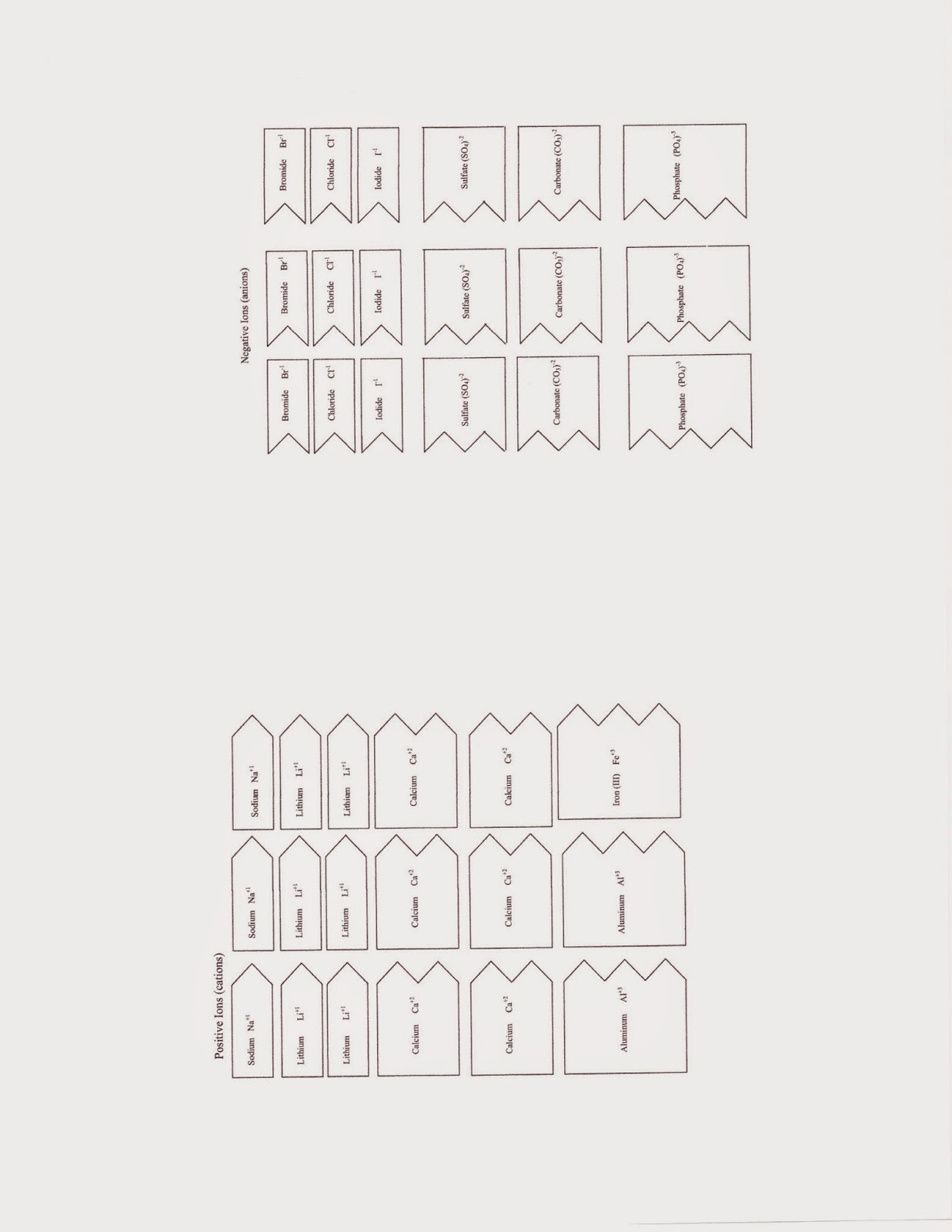
Students then made four new compounds and completed the worksheet. Find the worksheets for this section below.


Now make up four compounds from the remainder of the cations/anions. Be sure to record the formula, ration of metal to non-metal, the name of compound and type of bond. Paste the cutouts in the appropriate place.

These are the cutouts. I suggest coloring all the cations one color and the anions another color. Don't color so darkly that you can't read what's on the slip.

Monday, January 12, 2015

Monday/Tuesday, 12/13 January, 2015

ESSENTIAL QUESTION: How do molecules interact to form covalent bonds?

NGSSS: SC.912.P.8.6; SC.912.P.8.7

BENCHMARK(S):
-Distinguish between bonding forces holding compounds together and other attractive forces, including hydrogen bonding and van der Waals forces.  
-Interpret formula representations of molecules and compounds in terms of composition and structure.

LEARNING OBJECTIVES:  Students will be able to:
-distinguish between bonding forces holding compounds together and other attractive forces, including hydrogen bonding and an der Waals forces.

BELL RINGER: Read the cartoon and suggest elements for each character. Use your periodic table.


VOCABULARY: valence electron  electron dot structure, octet rule, halide ion, ionic bond, ionic compound, chemical formula, formula unit, coordination number, metallic bond, alloy

HOME LEARNING: HL 7/work on your science fair paper/project

INFORMATION PRESENTED IN CLASS:

Students completed the bell ringer and added it to their interactive notebook. Be sure you have placed the date, benchmark, essential question and page number in your table of contents. Then, set up a Cornell notes page with date, page number and essential question. Place the cartoon in the center of the Cornell notes page.

We then reviewed HL 8. 

Students then watched the BrainPop movie Chemical Bonds. You can access the movie with the user name: palm beach and password: palm beach.

We then completed a virtual covalent bonding activity, found at Covalent Bonding.

Students then began notes on covalent bonding. The entire powerpoint will be found on My Big Campus. Since we did not complete the entire chapter, I will post the completed power point on My Big Campus and the shortened movie version here when we do complete all four sections. 

Make sure all work is submitted by Wednesday.

Thursday, January 8, 2015

Thursday/Friday, 08/09 January, 2015

ESSENTIAL QUESTION: Why do bonds form between elements?

NGSSS: SC.912.P.8.6

BENCHMARK(S):
-Distinguish between bonding forces holding compounds together and other attractive forces, including hydrogen bonding and van der Waals forces.  

LEARNING OBJECTIVES:  Students will be able to:
-distinguish between ionic, covalent bonds, and metallic bonds and explain how they are formed.

BELL RINGER: Complete the five questions from the top of the handout with AT, NT or ST.

VOCABULARY: valence electron  electron dot structure, octet rule, halide ion, ionic bond, ionic compound, chemical formula, formula unit, coordination number, metallic bond, alloy

HOME LEARNING: HL 7/work on your science fair paper/project

INFORMATION PRESENTED IN CLASS:
Students completed questions 1-5 on the handout below, discussing why they chose the answers they did.
Bell ringer - complete questions 1-5 on THIS sheet. Place in your notebook.
HL 8. On your OWN paper, answer questions 6-13, placing ONLY the answers that would correctly complete each statement on your paper

Students reviewed home learning 7 and received instructions for HL 8, which can be found above.

We also completed note on ionic and metallic bonding. Remember, if you missed some of the notes, you can find the entire power point on My Big Campus. You can also find the shortened movie version of the notes on this site (see last class blog notes).

We then practiced recognizing bond types. The handout can be found below. Complete and place in your notebook.
Read the directions to write either ionic, covalent, or both for the bond types. You will also need a periodic table! Place the completed handout in your interactive notebook.

Students continued to practice making ionic bonds on their personal devices. Click the link Ionic Bonding to practice this skill.

Students also completed an exit slip on bonding.

Don't forget, projects are due in class on Monday!

Tuesday, January 6, 2015

Tuesday/Wednesday, 06/07 January, 2015

ESSENTIAL QUESTION: Why do bonds form between elements?

NGSSS: SC.912.P.8.6

BENCHMARK(S):
-Distinguish between bonding forces holding compounds together and other attractive forces, including hydrogen bonding and van der Waals forces.  

LEARNING OBJECTIVES:  Students will be able to:
-distinguish between ionic, covalent bonds, and metallic bonds and explain how they are formed.

BELL RINGER: Students were asked to draw the electron dot configurations for water (H2O), salt (NaCl), and carbon dioxide (CO2)

VOCABULARY: valence electron  electron dot structure, octet rule, halide ion, ionic bond, ionic compound, chemical formula, formula unit, coordination number, metallic bond, alloy

HOME LEARNING: HL 7/work on your science fair paper/project

INFORMATION PRESENTED IN CLASS:
Students received HL 7, which is to be done on your own paper. Be sure to write your answers on the handout and place in your interactive notebook.
This is HL 7. Be sure to answer all questions accordingly.

Students took notes on ionic and metallic bonding. The powerpoint, in movie form, is found below. You can find the actual and inclusive powerpoint on My Big Campus with today's date. Below, you will find a shortened version of that information. You need only take notes on the information printed in red.


This is the shortened version of the powerpoint, minus much of the explanatory information and examples. To see the entire powerpoint, please go to My Big Campus.

We will conclude notes next class.

Don't forget, papers and projects are due next Monday!

Home learning is due next class!

Friday, December 19, 2014

Friday, 19 December, 2014 and Monday, January 5, 2015

ESSENTIAL QUESTION: Why do bonds form between elements?

NGSSS: SC.912.P.8.6

BENCHMARK(S):
-Distinguish between bonding forces holding compounds together and other attractive forces, including hydrogen bonding and van der Waals forces.  

LEARNING OBJECTIVES:  Students will be able to:
-distinguish between ionic, covalent bonds, and metallic bonds and explain how they are formed.

BELL RINGER: Students were given handout and asked to draw the Lewis dot configuration of the valence electrons. 
Write the symbol for each element listed and place the valence electrons around each. This will help you learn which electrons are available to form bonds and to determine the types of bonds that can be formed.

VOCABULARY: valence electron  electron dot structure, octet rule, halide ion, ionic bond, ionic compound, chemical formula, formula unit, coordination number, metallic bond, alloy

HOME LEARNING: work on your science fair paper/project

INFORMATION PRESENTED IN CLASS:
After reviewing the bell ringer, we reviewed home learning 6. B sure to place both the bell ringer and the home learning in your interactive notebook.

Students then viewed the video Dogs Teaching Chemistry on forming bonds. They did a stop and jot as the video played. You can find the video below.
We then viewed a student-created video on forming bonds. We used the video (and a reference sheet) to take notes. You can find both of these handouts below the next video.
Use this sheet and the information from the video to help you complete the sheet below.

Complete this handout by using the video and the types of bonding handout. Both handouts should be placed in your notebook.

We will complete the topic on bonding when we return from Christmas break.

Have yourself a Merry Christmas!

Wednesday, December 17, 2014

Wednesday/Thursday, 17/18 December, 2014

ESSENTIAL QUESTION: Why do bonds form between elements?

NGSSS: SC.912.P.8.6

BENCHMARK(S):
-Distinguish between bonding forces holding compounds together and other attractive forces, including hydrogen bonding and van der Waals forces.  

LEARNING OBJECTIVES:  Students will be able to:
-distinguish between ionic, covalent bonds, and metallic bonds and explain how they are formed.

BELL RINGER: Use your phone to look up chemical formula for the vitamin you wrote about during the lat class. Also find the structural formula for your vitamin. Record both in your notes

VOCABULARY: valence electron  electron dot structure, octet rule, halide ion, ionic bond, ionic compound, chemical formula, formula unit, coordination number, metallic bond, alloy

HOME LEARNING: HL 6: Ionic and Metallic Bonding/work on your science fair paper/project

INFORMATION PRESENTED IN CLASS:
Students completed the bell ringer by writing the chemical formula and the structural formula for their chosen vitamin in their interactive notebook.

We then discussed how the the structural formula is how the molecule looks, while the chemical formula contains all the parts of the molecule. We noted that none of the vitamin molecules would be possible if the various elements could not bind together to make the compounds.

Students received HL 6, which can be found below:
This is HL 6. It is due next class. Answers only, on your own paper.

Students defined each of the words from the chapter, which are listed above in the vocabulary section.

Don't forget, home learning is due at the beginning of the next class!

Monday, December 15, 2014

Monday/Tuesday, 15/16 December, 2014

ESSENTIAL QUESTION: Why do bonds form between elements?

NGSSS: SC.912.P.8.6

BENCHMARK(S):
-Distinguish between bonding forces holding compounds together and other attractive forces, including hydrogen bonding and van der Waals forces.  

LEARNING OBJECTIVES:  Students will be able to:
-distinguish between ionic, covalent bonds, and metallic bonds and explain how they are formed.

BELL RINGER: Use your phone to look up a disease caused by a vitamin deficiency. You will prepare a poster depicting the vitamin and explaining how the lack of or low levels of that vitamin affect the body. You will also include a printed picture on your poster.

VOCABULARY: valence electron  electron dot structure, octet rule, halide ion, ionic bond, ionic compound, chemical formula, formula unit, coordination number, metallic bond, alloy

HOME LEARNING: work on your science fair paper/project

INFORMATION PRESENTED IN CLASS:
Students completed a poster about a disease caused by a vitamin deficiency. The poster should include a short description of the disease and how the lack of the particular vitamin causes the disease. It should also include a picture of someone affected with the disease.

Due to many students completing the exam, this is as far as we got in the lesson. For those who like to forge ahead, read chapter 7 and begin writing (and illustrating) al the vocabulary listed above.

Thursday, December 11, 2014

Thursday/Friday, 11/12 December, 2014

ESSENTIAL QUESTION: Exam

NGSSS: SC.912.P.10.9; SC.912.P.10.18

BENCHMARK(S):
-Describe the quantization of energy at the atomic level.
-Explore the theory of electromagnetism by comparing and contrasting the different parts of the electromagnetic spectrum in terms of wavelength, frequency, and energy, and relate them to phenomena and applications.    


LEARNING OBJECTIVES:  Students will be able to:
-take an exam on the quantum mechanical theory and electromagnetic spectrum.


BELL RINGER: NA

VOCABULARY: NA

HOME LEARNING: work on your science fair paper/project

INFORMATION PRESENTED IN CLASS:
Thursday was an early release day, therefore classes were shortened. There was also a writing boot camp given during the morning. Because of these factors, students were given the entire class time to work on their exam. Friday classes should expect to spend a comparable amount of time (about an hour) before moving onto other activities.

For the even block classes on Friday, students will do differentiated instruction, either individually using Edgenuity or work with the instructor to review information on which they received the lowest scores. Students should bring tablets to class!