Monday, November 30, 2015

Monday, 30 November and Tuesday, 01 December, 2015

ESSENTIAL QUESTION: Why do electrons emit light energy? 

RELEVANCE: How can I use an electron’s movement to determine its element?

NGSSS: SC.912.P.10.1; MAFS.912.N-Q.1.1; LAFS.910.WHST.1

LEARNING OBJECTIVES:  Students will be able to:
-conduct an investigation that determines the flame color of metals.
-continue quarterly project how does pH affect plant growth.

BELL RINGER: Electron Configurations # 1

VOCABULARY: wavelength, frequency, speed, electromagnetic spectrum, hertz

HOME LEARNING: HL 3 Electron Configurations 2-5

AGENDA
WHOLE GROUP

WE reviewed interdisciplinary connections wit ELA and other subjects. Today, we will write our claim, using the same method used in ELA. We area also practicing using reliable sources for information.

The bell ringer was to complete the first question on the home learning handout. 

Home learning 3 was then explained. You can find it below.
Use this sheet to answer the home learning. The bell ringer is question one on the bottom of the page.

This is HL 3. I will make a copy, so answers on this page. Write darkly.


We then viewed a video that explains how to record the quantum energy levels of elections of elements. You can watch the video below.

This is the video that will help you learn about electron configurations.


We continued working on writing up the laboratory, using the argument driven inquiry method. Since this is our first attempt at this type of write-up, we are doing the write-up using the gradual release method, with my writing what the class agrees to on the smart board.

SMALL GROUP/INDEPENDENT PRACTICE/DI
Students who compete work early should go to CK-12.org (log in with username and password) and do the physics simulation light wave. 

HOTS: 
-Justify why fireworks can allow you to determine the metal salts they contain.
-Speculate as to why light energy is given off when an electron returns to its original energy level and not when it moves up an energy level.


EXIT STRATEGY: completed lab write-up

Monday, November 23, 2015

Monday/Tuesday, 23/24 November, 2015

ESSENTIAL QUESTION: What is the electromagnetic spectrum?

RELEVANCE: How do I interact with the electromagnetic spectrum?

NGSSS: SC.912.P.10.1; MAFS.912.N-Q.1.1; LAFS.910.WHST.1

LEARNING OBJECTIVES:  Students will be able to:
-Identify the general properties of all electromagnetic waves.
-compare and contrast the types of radiation in the electromagnetic spectrum according to wavelength and frequency.
-conduct an investigation that determines the flame color of metals.
-continue quarterly project how does pH affect plant growth.

BELL RINGER: Density problem (P3) Kahoot.it of EM spectrum for periods 2 and 8.

VOCABULARY: wavelength, frequency, speed, electromagnetic spectrum, hertz

HOME LEARNING: HL 3 CER for lab

AGENDA
WHOLE GROUP

We reviewed our content connections with other courses. We are looking at sequencing, which is related to time lines done in Parenting classes and in Social Sciences.

The bell ringer for Period 3 was the Density Logic Puzzle. Other periods did a Kahoot.it on the Electromagnetic Spectrum.

We continued in our planning for the ADI lab Flame Test. Student actually completed the lab. We will continue the lab write-up next week.

SMALL GROUP/INDEPENDENT PRACTICE/DI
Students who compete work early should go to CK-12.org (log in with username and password) and do the physics simulation light wave. 

HOTS: 
-Why do gamma rays cause more damage than microwaves?
-Based on what you’ve learned about the EM Spectrum, justify a situation where it might be beneficial to use gamma rays or x-rays and explain why.


EXIT STRATEGY: write question for the experiment.

Thursday, November 19, 2015

Thursday/Friday, 19/20 November, 2015

ESSENTIAL QUESTION: What is the electromagnetic spectrum?

RELEVANCE: How do I interact with the electromagnetic spectrum?

NGSSS: SC.912.P.10.1; MAFS.912.N-Q.1.1; LAFS.910.WHST.1

LEARNING OBJECTIVES:  Students will be able to:
-Identify the general properties of all electromagnetic waves.
-compare and contrast the types of radiation in the electromagnetic spectrum according to wavelength and frequency.
-continue quarterly project how does pH affect plant growth.

BELL RINGER: Density problem

VOCABULARY: wavelength, frequency, speed, electromagnetic spectrum, hertz

HOME LEARNING: notebook update

AGENDA
WHOLE GROUP

We reviewed the current ELA objective and the relationship to other studies.

Our bell ringer was to complete the density problem, found below.
This is a graded bell ringer. Complete and submit for a grade.


Students checked the progress of the garden plots.

We began work on the lab. This lab will be an argument driven lab, so we spent some time reviewing the procedures for completing the handouts. To do this, we first read background information and took two column notes. These notes will especially be important in writing the reasoning section of our CER. 

We did not get further than this, but will continue the process next class.

SMALL GROUP/INDEPENDENT PRACTICE/DI
Students who compete work early should go to CK-12.org (log in with username and password) and do the physics simulation light wave. 

HOTS: 
-Why do gamma rays cause more damage than microwaves?
-Based on what you’ve learned about the EM Spectrum, justify a situation where it might be beneficial to use gamma rays or x-rays and explain why.


EXIT STRATEGY: write a question for the investigation.

Tuesday, November 17, 2015

Tuesday/Wednesday, 17/18 November, 2015

ESSENTIAL QUESTION: What is the electromagnetic spectrum?

RELEVANCE: How do I interact with the electromagnetic spectrum?

NGSSS: SC.912.P.10.1; MAFS.912.N-Q.1.1; LAFS.910.WHST.1

LEARNING OBJECTIVES:  Students will be able to:
-Identify the general properties of all electromagnetic waves.
-compare and contrast the types of radiation in the electromagnetic spectrum according to wavelength and frequency.
-continue quarterly project how does pH affect plant growth.

BELL RINGER: Label the types of wavelengths on the wavestown diagram. Compose a mnemonic devise to remember the order of the waves/problems from problem set

VOCABULARY: wavelength, frequency, speed, electromagnetic spectrum, hertz

HOME LEARNING: notebook update

AGENDA
WHOLE GROUP

We reviewed the interdisciplinary connections with ELA and other subjects.

Our bell ringer was to label, in correct order, the waves of the electromagnetic spectrum on the Wavestown handout received last class.

We continued to review problem sets so that students fully understand how to solve the frequency and wavelength problems.

Classes worked on their project by measuring and planting the plants in their garden bed. Although each class is responsible for a different bed, all data will be shared with all chemistry classes. For each day we measure, you must record the conditions (including pH of soil, temperature, sunlight/shade, watering).

For the plants, record the height of the tallest leaf/stem and the general health of the plant.

SMALL GROUP/INDEPENDENT PRACTICE/DI
Students who compete work early should go to CK-12.org (log in with username and password) and do the physics simulation light wave. 

HOTS: 
-Why do gamma rays cause more damage than microwaves?

-Based on what you’ve learned about the EM Spectrum, justify a situation where it might be beneficial to use gamma rays or x-rays and explain why.

Friday, November 13, 2015

Friday/Monday, 13/16 November, 2015

ESSENTIAL QUESTION: What is the electromagnetic spectrum?

RELEVANCE: How do I interact with the electromagnetic spectrum?

NGSSS: SC.912.P.10.1; MAFS.912.N-Q.1.1; LAFS.910.WHST.1

LEARNING OBJECTIVES:  Students will be able to:
-Identify the general properties of all electromagnetic waves.
-compare and contrast the types of radiation in the electromagnetic spectrum according to wavelength and frequency.

BELL RINGER: Label the types of wavelengths on the wavestown diagram. Compose a mnemonic devise to remember the order of the waves.

VOCABULARY: wavelength, frequency, speed, electromagnetic spectrum, hertz

HOME LEARNING: notebook update

AGENDA
WHOLE GROUP

We reviewed the interdisciplinary connections with ELA and other subjects.

Our bell ringer was to label the Wavestown diagram with the names of the waves of the electromagnetic spectrum.

We then watched a BrainPop on the electromagnetic spectrum. You can watch the video by clicking the link Electromagnetic Spectrum and signing in with the user name and password palmbeach.

Home learning 2 was collected and reviewed. 

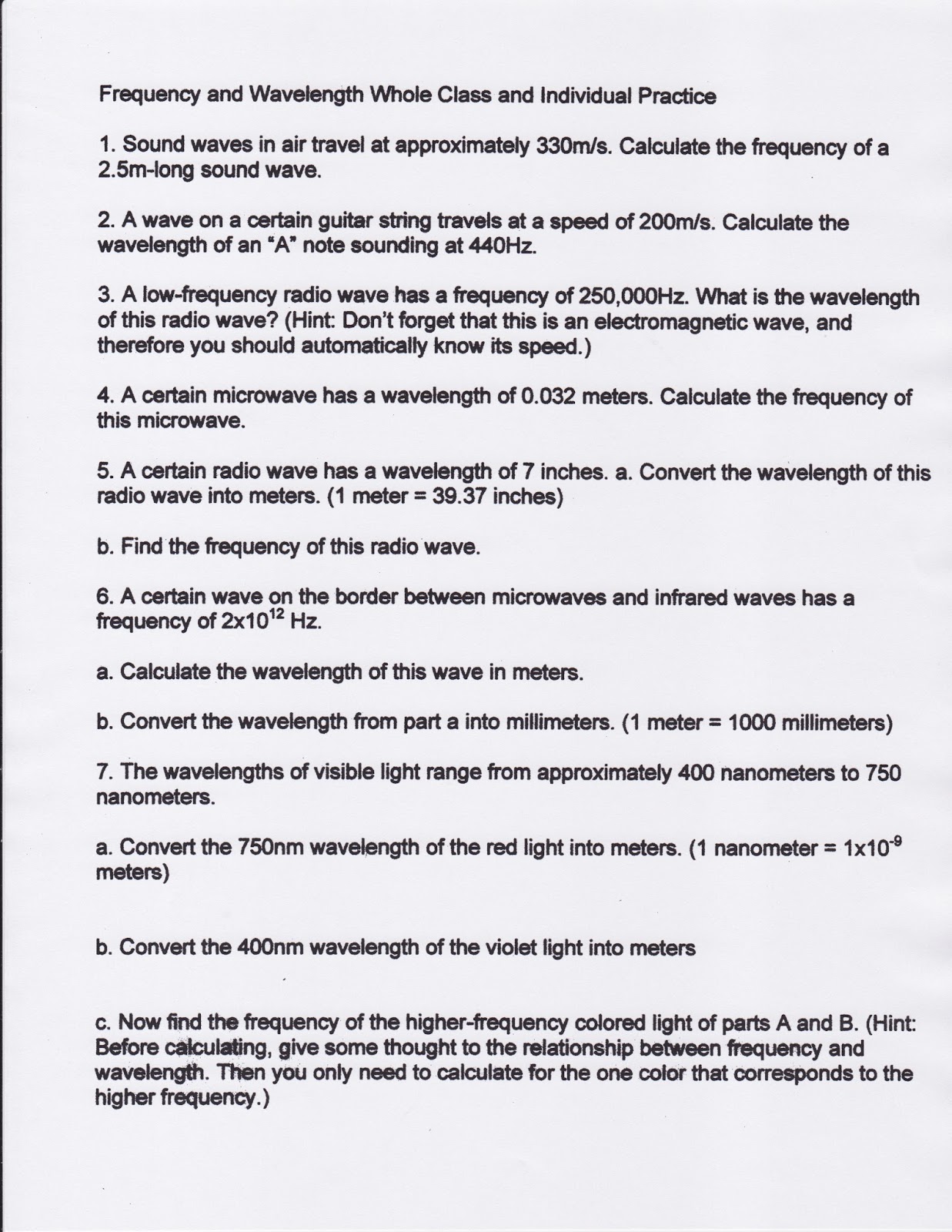
A new problem set was distributed and reviewed. You can find it below. If we do not complete in class, please complete at home. You can find a scientific calculator online at Google chrome by googling scientific calculator.
Try these problems to test your knowledge.


Students worked in groups of 2 or 3, each team being assigned a type of electromagnetic wave. They used the Wavestown picture, which you received last class, to list the different ways the waves are represented in the picture. See if you can get them all!

We then shared out the information to the entire class. These pages should be placed in your notebook.

SMALL GROUP/INDEPENDENT PRACTICE/DI
Students who compete work early should go to CK-12.org (log in with username and password) and do the physics simulation light wave. 

HOTS: 
-Why do gamma rays cause more damage than microwaves?
-Based on what you’ve learned about the EM Spectrum, justify a situation where it might be beneficial to use gamma rays or x-rays and explain why.


EXIT STRATEGY: Exit slip - solve the problems.

Tuesday, November 10, 2015

Tuesday/Thursday, 10/12 November, 2015

ESSENTIAL QUESTION: What is the electromagnetic spectrum?

RELEVANCE: How do I interact with the electromagnetic spectrum?

NGSSS: SC.912.P.10.1; MAFS.912.N-Q.1.1; LAFS.910.WHST.1

LEARNING OBJECTIVES:  Students will be able to:
-Identify the general properties of all electromagnetic waves.
-compare and contrast the types of radiation in the electromagnetic spectrum according to wavelength and frequency.
-determine how pH affects plant growth.
-make-up exam for QSBA1

BELL RINGER: Solve for the following: What is the frequency of a sodium wave if the wavelength is 425 nm?

VOCABULARY: wavelength, frequency, speed, electromagnetic spectrum, hertz

HOME LEARNING: HL 2 The electromagnetic spectrum

AGENDA
WHOLE GROUP

Students practiced how to solve frequency and wavelength problems by working through the bell ringer. We then practiced more problems to help students become proficient in solving problems.

Students received home learning 2. We read and reviewed the home learning, again demonstrating how to work the problems. We discussed how to read the electromagnetic spectrum chart. You can find the handout below.

This is HL 2. Answers on your own paper. Be sure to check for units. Show your work for full credit.


Students received the handouts that will serve as notes. However, we did not have time to review them, as we worked on setting up the garden plot for the project. You can find the handouts below.


These will serve as notes for this section.


SMALL GROUP/INDEPENDENT PRACTICE/DI
Students who compete work early should go to CK-12.org (log in with username and password) and do the physics simulation light wave. 

HOTS: 
-Why do gamma rays cause more damage than microwaves?
-Based on what you’ve learned about the EM Spectrum, justify a situation where it might be beneficial to use gamma rays or x-rays and explain why.


EXIT STRATEGY: Problems 11-13 on handout.

Friday, November 6, 2015

Friday/Monday, 06/09 November, 2015

ESSENTIAL QUESTION: How did the atomic theory develop?/How does pH affect plant growth?

RELEVANCE: Why do science facts keep changing?

NGSSS: SC.912.P.8.3; MAFS.912.N-Q.1.1; LAFS.910.WHST.1

LEARNING OBJECTIVES:  Students will be able to:
-Compare and contrast the varying atomic theories of the past.
-Justify why the atomic theory has changed over time.
-Set up the experimental plots for the project to determine how pH affects plant growth.
-Take the District QSBA1 exam.

BELL RINGER: ten minute study time

VOCABULARY: theory, law

HOME LEARNING: notebook update

AGENDA
WHOLE GROUP

Students were given a ten minute study/review period before the district QSBA 1 exam was administered. Although this is not a timed test, students were given the entire period to complete the exam.

Wednesday, November 4, 2015

Wednesday/Thursday, 04/05 November, 2015

ESSENTIAL QUESTION: How did the atomic theory develop?

RELEVANCE: Why do science facts keep changing?

NGSSS: SC.912.P.8.3; MAFS.912.N-Q.1.1; LAFS.910.WHST.1

LEARNING OBJECTIVES:  Students will be able to:
-Compare and contrast the varying atomic theories of the past.
-Justify why the atomic theory has changed over time.
-Set up the experimental plots for the project to determine how pH affects plant growth.

BELL RINGER: Write to explain why you think the atomic theory has changed over time.

VOCABULARY: theory, law

HOME LEARNING: HL 1 Flow chart of development of the atomic theory

AGENDA
WHOLE GROUP

The bell ringer was to write to explain why you think the atomic theory has changed over time.

Students received HL 1. The flow chart should include the person who discovered the theory, the year of the discovery, and a drawing of the atomic model proposed by that scientist. flow chart should be done in time sequential order from the earliest theory to the modern theory. You can find the handout below.
Us this to make a flow chart on the progress of the atomic theory. Write darkly. I will make a copy and return the original.


 Students then completed a gallery walk of the atomic theory, completing the handout. You can find the handout and the station cards below.

Use these handouts to record your notes from the gallery walk.


These six stations are to recorded in your notes. Be sure to answer the questions asked with information from the correct station.

Monday, November 2, 2015

Monday/Tuesday, 02/03 November, 2015

ESSENTIAL QUESTION: How did the atomic theory develop?

RELEVANCE: Why do science facts keep changing?

NGSSS: SC.912.P.8.3; MAFS.912.N-Q.1.1; LAFS.910.WHST.1

LEARNING OBJECTIVES:  Students will be able to:
-Compare and contrast the varying atomic theories of the past.
-Justify why the atomic theory has changed over time.

BELL RINGER: Describe the cookie dough for chocolate chip cookies. Be descriptive as possible.

VOCABULARY: theory, law

HOME LEARNING: notebook update

AGENDA
WHOLE GROUP

The bell ringer was to describe cookie for chocolate chip cookies and relate it to one of the atomic theories of the past.

We then watched a video on the development of the atomic theory. You can watch the video below.

Watch the video to learn about the development of the atomic theory.

Students then read from the text on the atomic theory.

Wednesday, October 28, 2015

Wednesday/Thursday, 28/29 October, 2015

ESSENTIAL QUESTION: What pH is best for plant growth?

RELEVANCE: How can I grow bigger vegetables?

NGSSS: SC.912.N.1.1; MAFS.912.N-Q.1.1; LAFS.910.WHST.1

LEARNING OBJECTIVES:  Students will be able to:
-Complete the first grading period project.

BELL RINGER: on a sticky, write to describe all essentials for plant growth

VOCABULARY: hypothesis, materials, procedures, variables

HOME LEARNING: notebook update

AGENDA
WHOLE GROUP

Students were given a 40 minute exam correction period. Students absent for the initial exam were given the entire period.

Students spent the remainder of the class working on their research plan. You can find the plan below in movie form. Go to Slide Share (the link is below) to see the actual slide show.

This is the research plan in video form. Click the link below for the actual slide show.


Monday, October 26, 2015

Monday/Tuesday, 26/27 October, 2015

ESSENTIAL QUESTION: What topics have we studied this quarter? 

RELEVANCE: Quarter Exam

ESSENTIAL QUESTION: What have I learned this quarter?

RELEVANCE: I CAN pass a quarterly exam!

NGSSS: SC.912.N.1.1; SC.912.P.8.1; SC.912.P.8.2; SC.912.P.8.4; SC.912.P.8.5; MAFS.912.N-Q.1.1; LAFS.910.WHST.1

LEARNING OBJECTIVES:  Students will be able to:
-Take an exam covering information presented this grading period.

BELL RINGER: NA

VOCABULARY: cumulative for quarter.

HOME LEARNING: notebook update

AGENDA
WHOLE GROUP

Students turned in and reviewed home learning 9.

Students then had a 15 minute study period.

Finally, students took a quarter exam that covered information presented during the entire grading period.

Thursday, October 22, 2015

Thursday/Friday, 22/23 October, 2015

ESSENTIAL QUESTION: How are elements arranged?

RELEVANCE: Why use a periodic table?

NGSSS: SC.912.P.8.3; SC.912.P.8.4; SC.912.P.8.5; MAFS.912.N-Q.1.1; LAFS.910.WHST.1

LEARNING OBJECTIVES:  Students will be able to:
-Read and interpret a periodic table.
-Describe how the elements are arranged on the periodic table.
-Distinguish between the different families of elements and their properties.

BELL RINGER: Read the challenge. Highlight the section that explains which elements are the same and which are different on earth and on Chykogon.

VOCABULARY: atom, atomic number, electron, electron dot diagram, element, energy level, ion, isotope, mass number, neutron, nucleus, periodic table, proton, radioactive, valence electrons

HOME LEARNING: HL 9, study for exam

Students identified the problem by reading the background information as their bell ringer.

Students received HL 9, which is due next class. Print two copies. One is to be placed in your interactive notebook. The other copy is to submit. You can find the handout below.

This is HL 9. Be sure to turn in a copy to me and keep one for yourself.

Classes that needed to complete the notes and vocabulary (due to testing) did so. You can find the information for the notes on the last blog. Be sure to define the following: periodic law, alkali metals, alkaline earth metals, transition metals, metalloids, nonmetals, halogens, and noble gases.

We then worked on the Chykogon Periodic Table. You can find the handouts below. Be sure to place them in your notebook with this section.


Complete the handouts and place in your notebook. Remember, compare the Chykogonian elements to those found on Earth to discover their names and positions on the periodic table.

Tuesday, October 20, 2015

Tuesday/Wednesday, 20/21 October, 2015

ESSENTIAL QUESTION: How are elements arranged?

RELEVANCE: Why use a periodic table?


NGSSS: SC.912.P.8.3; SC.912.P.8.4; SC.912.P.8.5; MAFS.912.N-Q.1.1; LAFS.910.WHST.1

LEARNING OBJECTIVES:  Students will be able to:
-Read and interpret a periodic table.
-Describe how the elements are arranged on the periodic table.
-Distinguish between the different families of elements and their properties.

BELL RINGER: Read the challenge. Highlight the section that explains which elements are the same and which are different on earth and on Chykogon.

VOCABULARY: atom, atomic number, electron, electron dot diagram, element, energy level, ion, isotope, mass number, neutron, nucleus, periodic table, proton, radioactive, valence electrons

HOME LEARNING: update notebook, complete vocabulary, study

AGENDA
WHOLE GROUP

For the bell ringer, students read the introduction to the activity and determined which sentence supplied information about the similarities between the Chykogen elements and those found on Earth.

Some students continued the grouping of the elements of the periodic table by family activity. Be sure to include your key.

Students also completed notes on the elements and the periodic table. They first completed the table below with the correct information.

Parts of the Atom

Particle Name        Charge       Location      AMU
Proton
Neutron
Electron

Students then wrote note, including:

# protons = atomic number

# protons + # neutrons = atomic mass

Atomic mass - # protons = # neutrons

An atom has no charge, having the same number of protons and electrons (# protons = # electrons).
An ion is charged, having either more protons or electrons.

Finally, students were asked to define the following:
periodic law
alkali metals
alkaline earth metals
transition metals
metalloids
nonmetals
halogens
noble gases

Friday, October 16, 2015

Friday/Monday, 16/19 October, 2015

ESSENTIAL QUESTION: How are elements arranged?

RELEVANCE: Why use a periodic table?


NGSSS: SC.912.P.8.3; SC.912.P.8.4; SC.912.P.8.5; MAFS.912.N-Q.1.1; LAFS.910.WHST.1

LEARNING OBJECTIVES:  Students will be able to:
-Read and interpret a periodic table.
-Describe how the elements are arranged on the periodic table.
-Distinguish between the different families of elements and their properties.

BELL RINGER: Can you name the places? Plus space to create one on your own!

VOCABULARY: atom, atomic number, electron, electron dot diagram, element, energy level, ion, isotope, mass number, neutron, nucleus, periodic table, proton, radioactive, valence electrons

HOME LEARNING: There is no separate home learning, except to complete vocabulary and study!

AGENDA
WHOLE GROUP

The bell ringer was similar to HL 8. Complete the handout using the periodic table to name the places. Use the fifth space to make up a name, place, or thing, using the symbols from the periodic table. Exchange with a shoulder buddy to see if you can solve their puzzle and if you can solve theirs! You can find the handout below. It will go in the center space of your Cornell notes.

This is the bell ringer. Find the answers using your periodic table. Use the provided space to make up your own mystery word, name, animal, or place.


We collected and reviewed HL 8.

Students color coded their periodic tables by families. There should be at least 9 families. Be sure to use your key. You can use the periodic table below as a guide. You DO NOT have to have the same colors for the families on your table. However, be sure to correctly label the families you include. 

Wednesday, October 14, 2015

Wednesday/Thursday, 14/15 October, 2015

ESSENTIAL QUESTION: How are elements arranged?

RELEVANCE: Why use a periodic table?


NGSSS: SC.912.P.8.3; SC.912.P.8.4; SC.912.P.8.5; MAFS.912.N-Q.1.1; LAFS.910.WHST.1

LEARNING OBJECTIVES:  Students will be able to:
-Compare the sizes, charges, and relative positions of the subatomic particles.
-Relate an atom’s number of protons to its charge, name, and atomic number.
-Calculate the mass number of an atom.
-Create an electron dot diagram for elements.

BELL RINGER: Cloze activity The Periodic  Table

VOCABULARY: atom, atomic number, electron, electron dot diagram, element, energy level, ion, isotope, mass number, neutron, nucleus, periodic table, proton, radioactive, valence electrons

HOME LEARNING: HL 8 Periodic Table Worksheet

AGENDA
WHOLE GROUP

Students completed a cloze activity on the periodic table. You can find the handout below.

This is the bell ringer. It will be placed with your notes for this essential question.


Students received a periodic table and HL 8. They can be found below. Be sure to write your answers for HL 8 on your own paper to submit.
Use this periodic table to complete your home learning assignment.

This is HL 8. Complete using the periodic table. Be sure to make a copy on your own paper to submit for a grade. Also, record the due date and your grade in your notebook.

Students also received a vocabulary list for this topic Be sure to draw, list an example, or write something to remind you of what the word means.

This is the vocabulary necessary for understanding this topic. Be sure to complete and place with this topic's notes.


We then completed the Gizmo activity Element builder. Students are mandated to complete the assessment for the Gizmo.

SMALL GROUP/INDEPENDENT PRACTICE/DI
Students who compete work early should go to Dr. Gayden’s Science Zone and learn more about atoms by completing the pHET activity.

Be sure you can answer the following Higher Order Thinking questions!

HOTS: 
-What do you notice about the valence electrons in all noble gases? 
-What elements have only one valence electron? What does this tell you about these elements?

EXIT STRATEGY: assessment at end of Gizmo

Monday, October 12, 2015

Monday/Tuesday, 12/13 October, 2015

ESSENTIAL QUESTION: How are elements arranged?

RELEVANCE: Why use a periodic table?


NGSSS: SC.912.P.8.3; SC.912.P.8.4; SC.912.P.8.5; MAFS.912.N-Q.1.1; LAFS.910.WHST.1

LEARNING OBJECTIVES: Students will be able to:
-Compare the sizes, charges, and relative positions of the subatomic particles.
-Relate an atom's number of protons to its charge, name, and atomic number.
-Calculate the mass number of an atom.
-Create an electron dot diagram for elements.

BELL RINGER: Students previewed pages 160-180 in the text and choose a method of representing the periodic table. They then wrote a poem, in any form and illustrated the poem in color.

VOCABULARY: atom, atomic number, electron, electron dot diagram, element, energy level, ion, isotope, mass number, neutron, nucleus, periodic table, proton, radioactive, valence electrons

HOME LEARNING: notebook update for notebook check

AGENDA
WHOLE GROUP

Students completed the bell ringer.

Students also reviewed HL 7.

We viewed the BrainPop movie The Periodic Table. You can watch the video by searching the site (www.brainpop.com) for the title. Use the log in username and pass word palmbeach.

We then worked on the prior knowledge questions and the Gizmo warm up for the Gizmo Element Builder. You can find the handouts by logging into www.explorelearning.com with the user name and password I have supplied to you. If you cannot remember your user name and password, please email me at DrGCDMS@dadeschools.net.

It is mandatory that you complete the assessment at the end of the Gizmo.