Wednesday, October 25, 2017

Thursday/Friday, 25/26 October, 2017


NOTE _ Period 6 did not meet on Thursday due to the Fall Harvest Festival. They completed all work on Tuesday. See that blog to determine what you missed.

ESSENTIAL QUESTION: How has the Atomic Model changed over time?

LEARNING TARGET: Describe how the modern atomic theory was developed.
BENCHMARKS: SC.912.P.8.3

LEARNING OBJECTIVES:  Students will be able to:
-Complete the Separation of Mixtures lab write up.
-Describe the atomic theory and the reasons for the changes in the model over time.
-Describe the structure of atoms in terms of protons, neutrons, and electrons, and differentiate among these particles in terms of mass, electrical changes and location within the atom.

BELL RINGER - Your guide to the atom


VOCABULARY: alkali metals, alkaline earth metals, group (family), halogen, inner transition (rare earth metals), ion, metal, metalloid, noble gas, notation, nonmetal, octet rule

HOME LEARNING: update notebook

AGENDA
WHOLE GROUP

Students labeled the atom as their bell ringer.

We then completed notes (see last blog for move of power point) for those students who needed to complete them.

Students also had the chance to complete the Gizmo on Mystery Powder Analysis and submit it.

Monday, October 23, 2017

Monday/Tuesday, 23/24 October, 2017

ESSENTIAL QUESTION: How has the Atomic Model changed over time?

LEARNING TARGET: Describe how the modern atomic theory was developed.

BENCHMARKS: SC.912.P.8.3

LEARNING OBJECTIVES:  Students will be able to:
-Complete the Separation of Mixtures lab write up.
-Describe the atomic theory and the reasons for the changes in the model over time.
-Describe the structure of atoms in terms of protons, neutrons, and electrons, and differentiate among these particles in terms of mass, electrical changes and location within the atom.

BELL RINGER - Choose an element and record the protons, neutrons, and electrons for that element’s atom.
VOCABULARY: alkali metals, alkaline earth metals, group (family), halogen, inner transition (rare earth metals), ion, metal, metalloid, noble gas, notation, nonmetal, octet rule

HOME LEARNING: update notebook
AGENDA
WHOLE GROUP

Students chose an element to share with the class, noting its number of protons, neutrons, and electrons.

We completed the separation of mixtures lab.

Students then did the notes for the atomic theory. Students used the handout below to record their information.


You can find the power point in video form with which to complete the notes below.


Thursday, October 19, 2017

Thursday/Friday, 19/20 October, 2017

ESSENTIAL QUESTION: How has the Atomic Model changed over time?

LEARNING TARGET: Describe how the modern atomic theory was developed.

NGSSS: SC.912.P.8.3

BENCHMARKS:
-Explore the scientific theory of atoms (also known as atomic theory) by describing changes in the atomic model over time and why those changes were necessitated by experimental evidence.

LEARNING OBJECTIVES:  Students will be able to:
-Describe the structure of atoms in terms of protons, neutrons, and electrons, and differentiate among these particles in terms of mass, electrical changes and location within the atom.
-Complete the Separation of Mixtures lab write up.
-Research information for project It’s Simply Elemental!.

BELL RINGER - ! and 2 of Atomic structure worksheet


VOCABULARY: alkali metals, alkaline earth metals, group (family), halogen, inner transition (rare earth metals), ion, metal, metalloid, noble gas, notation, nonmetal, octet rule

HOME LEARNING: work on project
AGENDA
WHOLE GROUP

Students completed number one on the handout above, identifying the particles of an atom and their charge.

Students then completed work on their projects.

Tuesday, October 17, 2017

Tuesday/Wednesday, 17/18 October, 2017

ESSENTIAL QUESTION: How has the Atomic Model changed over time?

LEARNING TARGET: Describe how the modern atomic theory was developed.

BENCHMARKS: SC.912.P.8.3

LEARNING OBJECTIVES:  Students will be able to:
-Describe the development and historical importance of atomic theory from Dalton, (atomic theory), Thomson (the electron), Rutherford (the nucleus and “gold foil” experiment), an Bohr (planetary model of atom).
Describe the structure of atoms in terms of protons, neutrons, and electrons, and differentiate among these particles in terms of mass, electrical changes and location within the atom.
-research information for project It’s Simply Elemental!.

BELL RINGER - Atomic Structure and Theory Magic Number Handout
Complete the handout by working together and reading the information from the following note pages:

Use this information to complete the bell ringer handout.


Students took about 20 minutes to discuss and complete the bell ringer. 

They spent the remainder of the period working on their presentation.

Friday, October 13, 2017

Friday/Monday, 13/16 October, 2017

ESSENTIAL QUESTION: How can matter be separated?

LEARNING TARGET: Calculate percent error in an experiment on separation of mixtures

BENCHMARKS: SC.912.P.8.2

LEARNING OBJECTIVES:  Students will be able to:
-Complete separation of mixtures lab.
-research information for project It’s Simply Elemental!.

BELL RINGER - Set up lab in lab book
VOCABULARY: chemical change, chemical property, physical change, physical property, homogeneous, heterogeneous, element, compound, mixture, substance, extensive properties, intensive properties, density, mass, volume, filtration, suspension, solution, solute, solvent

HOME LEARNING: HL 7 Mixtures/work on project
AGENDA
WHOLE GROUP

I was out of the classroom on Wednesday, 11 October, so those students did not receive HL 7. All students should have HL 7 ready to turn in by next class period.

We continued to write up the lab in our lab book. 

Students also had time to work on their element project, which is due next week.

Wednesday, October 11, 2017

Wednesday/Thursday, 11/12 October, 2017

ESSENTIAL QUESTION: How can matter be separated?

LEARNING TARGET: Use separation techniques to separate homogeneous and heterogenous mixtures

BENCHMARKS: SC.912.P.8.2

LEARNING OBJECTIVES:  Students will be able to:
-Use separation techniques to separate mixtures into their component parts.

BELL RINGER - separation of mixtures worksheet (see last class)
VOCABULARY: chemical change, chemical property, physical change, physical property, homogeneous, heterogeneous, element, compound, mixture, substance, extensive properties, intensive properties, density, mass, volume, filtration, suspension, solution, solute, solvent

HOME LEARNING: notebook update
AGENDA
WHOLE GROUP

Students made their lab journal and began the write up for the separation of mixtures lab as their bell ringer.

Students received HL 7. See below.

We continued with the lab experiment and write up.

The remaining class time was spent working on the element project.

Monday, October 9, 2017

Monday/Tuesday, 09/10 October, 2017

ESSENTIAL QUESTION: How can matter be separated?

BENCHMARKS: SC.912.P.8.2
LEARNING OBJECTIVES:  Students will be able to:
-Use separation techniques to separate mixtures into their component parts.

BELL RINGER - separation of mixtures worksheet (see last class)

VOCABULARY: chemical change, chemical property, physical change, physical property, homogeneous, heterogeneous, element, compound, mixture, substance, extensive properties, intensive properties, density, mass, volume, filtration, suspension, solution, solute, solvent

HOME LEARNING: notebook update

AGENDA
WHOLE GROUP

Students completed the separation of mixtures bell ringer from last class.

Students then submitted HL 6 and reviewed.

Students needing to correct tests did so.

We did the separation of mixtures lab, but did not complete the write up. We will do so next class period.

Thursday, October 5, 2017

Thursday/Friday, 05/06 October, 2017

ESSENTIAL QUESTION: How can matter be separated?

BENCHMARKS: SC.912.P.8.2

LEARNING OBJECTIVES:  Students will be able to:
-Explain how mixtures can be separated into their components.

BELL RINGER - separation of mixtures worksheet


VOCABULARY: chemical change, chemical property, physical change, physical property, homogeneous, heterogeneous, element, compound, mixture, substance, extensive properties, intensive properties, density, mass, volume, filtration, suspension, solution, solute, solvent

HOME LEARNING: HL 6 Chemicals are Everywhere


AGENDA
WHOLE GROUP

Students worked on the bell ringer above. We will complete it as we do the lab.

Students received HL 6, which can be found above. All answers should be on your own paper.

Students received the information for the first project, which can be found below. I will give you a list of possible topics next class. You will also have some time next class to work on your research.


We reviewed the most missed questions on the exam and then students corrected their exam.

Tuesday, October 3, 2017

Tuesday/Wednesday, 03/04 October, 2017

Students had a short study/review session before taking an assessment on laboratory safety, the scientific method, chemical and physical properties, and density.

Thursday, September 28, 2017

Thursday/Friday, 28/29 September, 2017

ESSENTIAL QUESTION: What is Density?

BENCHMARKS: SC.912.P.8.2

LEARNING OBJECTIVES:  Students will be able to:
-Contrast mixtures and pure substances.
-Distinguish between elements, compounds, and mixtures.

BELL RINGER - Watch video Can you solve the Boat Puzzle and answer question.

VOCABULARY: chemical change, chemical property, physical change, physical property, homogeneous, heterogeneous, element, compound, mixture, substance, extensive properties, intensive properties, density, mass, volume

HOME LEARNING: Study for exam

AGENDA

Students first set up a new Cornell notes section for Density with the above benchmark and essential question.

For the bell ringer, students watched the video below and either answered the question presented (what happens to the water level if you take a rock from the boat and place it in the water?) or authored their own level 2 question that can be answered from the video.

You can find the video below:


Students then took notes on density, which can be found in movie form below:


Students are to study for an exam on laboratory safety, the scientific method including variables, the properties of matter, and density.

The class that needed to complete their exit ticket on compounds and mixtures did so.

Tuesday, September 26, 2017

Tuesday/Wednesday, 26/27 September, 2017

ESSENTIAL QUESTION: What is Density?

BENCHMARKS: SC.912.P.8.2

LEARNING OBJECTIVES:  Students will be able to:
-Contrast mixtures and pure substances.
-Distinguish between elements, compounds, and mixtures.

BELL RINGER - Watch video Can you solve the Boat Puzzle and answer question.

VOCABULARY: chemical change, chemical property, physical change, physical property, homogeneous, heterogeneous, element, compound, mixture, substance, extensive properties, intensive properties, density, mass, volume

HOME LEARNING: HL 4 Density    HL 5 Density
These pages are HL 4. Place your answers on this sheet and I will copy.

This is HL 5. Write directly on the page and I will copy for you.

AGENDA
WHOLE GROUP

Students reviewed HL 4 and 4 as their bell ringer.

Students finalized the handouts and information for topic 3 in their notebook, including questions and summary.

Students then put together the remaining pages in their notebook, which consisted of pages:

5: the log to record scores on major District exams, for each benchmark.

6: individual independent assignment log

7: year at a glance

8: major projects/papers for the year

a: Costa's leveled questions for the left hand column of the Cornell notes.

b. examples of quality questions for the left hand column

c and d: standards that will be tested during the 8th grade Science FCAT. This includes all the big ideas taught in 8th grade and the     annually accessed standards from 6th, 7th, and 8th grade that will be included on the test.

inside back cover: contact information/password log

Students spent the remainder of the period in individual remediation on past topics.

Classes that needed to complete the exit ticket from the Venn diagram did so.

Friday, September 22, 2017

Friday/Monday, 22/25 September, 2017

ESSENTIAL QUESTION: How are properties used to describe matter?

BENCHMARKS: SC.912.P.8.2

LEARNING OBJECTIVES:  Students will be able to:
-Contrast mixtures and pure substances.
-Distinguish between elements, compounds, and mixtures.

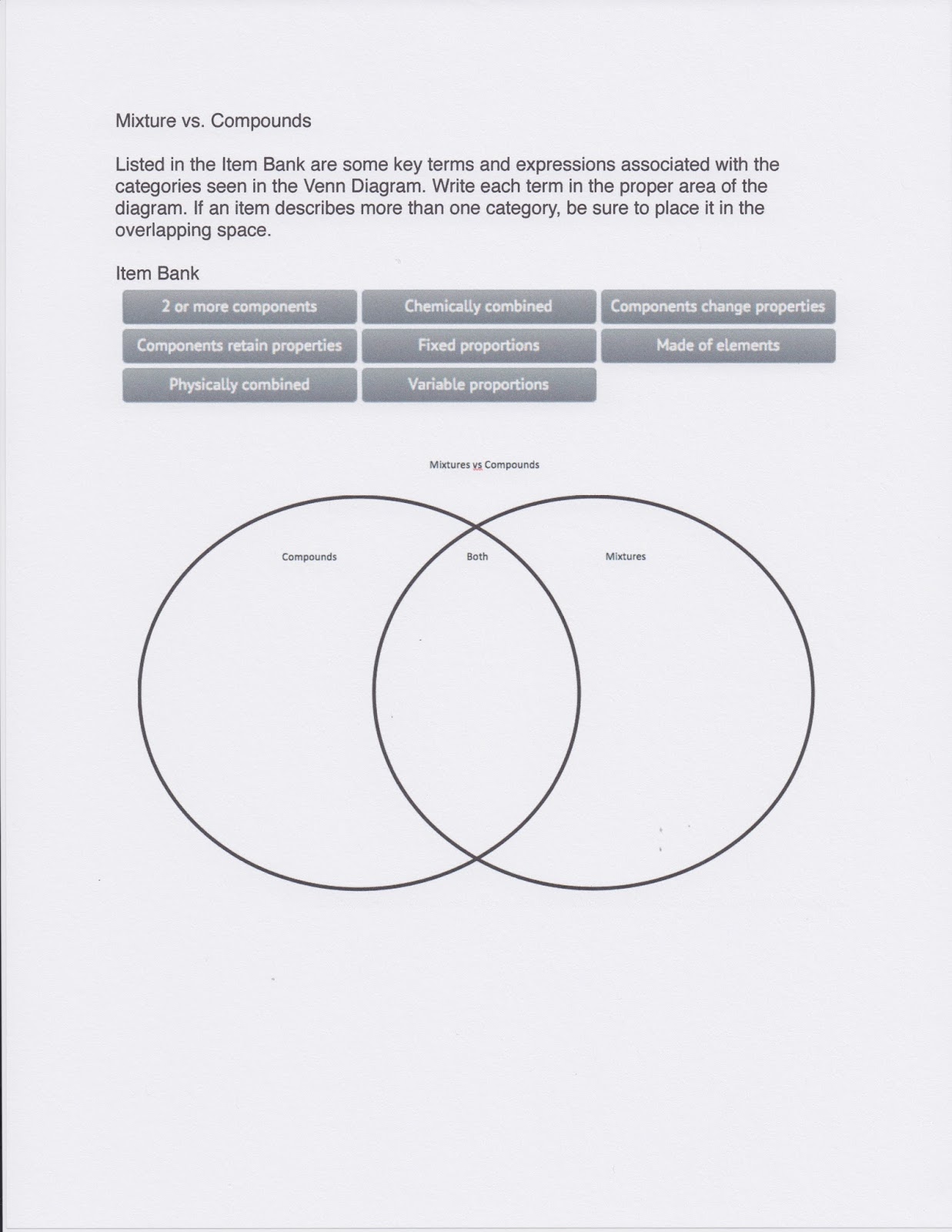
BELL RINGER - Mixtures vs Compounds Venn Diagram


VOCABULARY: chemical change, chemical property, physical change, physical property, homogeneous, heterogeneous, element, compound, mixture, substance, extensive properties, intensive properties

HOME LEARNING: HL 4 Density    HL 5 Density


 The above is HL 4


The above is HL 5


AGENDA
WHOLE GROUP

Students completed the Venn diagram on mixtures vs compounds as the bell ringer.

We then reviewed the Bozeman video and completed the concept map on matter and the phases of matter, which can be found below. The video is also found below.


Complete as you watch the video below on matter


We then reviewed and explained how to complete HL 4 and HL 5, as seen above.

Notes on matter were continued. You can find the power point presentation in video form below.


Students will use the completed Venn diagram to write a comparison and contrast paper on pure substances and mixtures as their exit ticket.

Wednesday, September 20, 2017

Tuesday/Wednesday, 20/21 September, 2017

Students took the pre test in chemistry.

Students also received HL 3, the Density Logic Puzzle

Students began working on the GIZMO Mystery Powder Analysis

Tuesday, September 5, 2017

Tuesday/Wednesday, 05/06 September, 2017

ESSENTIAL QUESTION: How are properties used to describe matter?

BENCHMARKS: SC.912.P.8.2

LEARNING OBJECTIVES:  Students will be able to:
-Contrast mixtures and pure substances.

-Distinguish between elements, compounds, and mixtures.

BELL RINGER: Scientific Method Variables quiz/Physical and Chemical Properties

VOCABULARY: chemical change, chemical property, physical change, physical property, homogeneous, heterogeneous, element, compound, mixture, substance, extensive properties, intensive properties

HOME LEARNING: HL 2: Elements, Compounds and Mixtures

AGENDA
WHOLE GROUP

Students completed a quiz on variables.

Students then completed a bell ringer on physical and chemical properties.


Students received Home Learning 2, which can be found above. It is due next class period.

Students began notes on matter classification. You can watch the power point in video form below. Just click to pause so you can add your notes.


Students should prepare for a baseline exam next week.